Dragon Soul Press had the opportunity to interview Carisa H-K, an author featured in DSP’s Once Upon a Tale anthology.
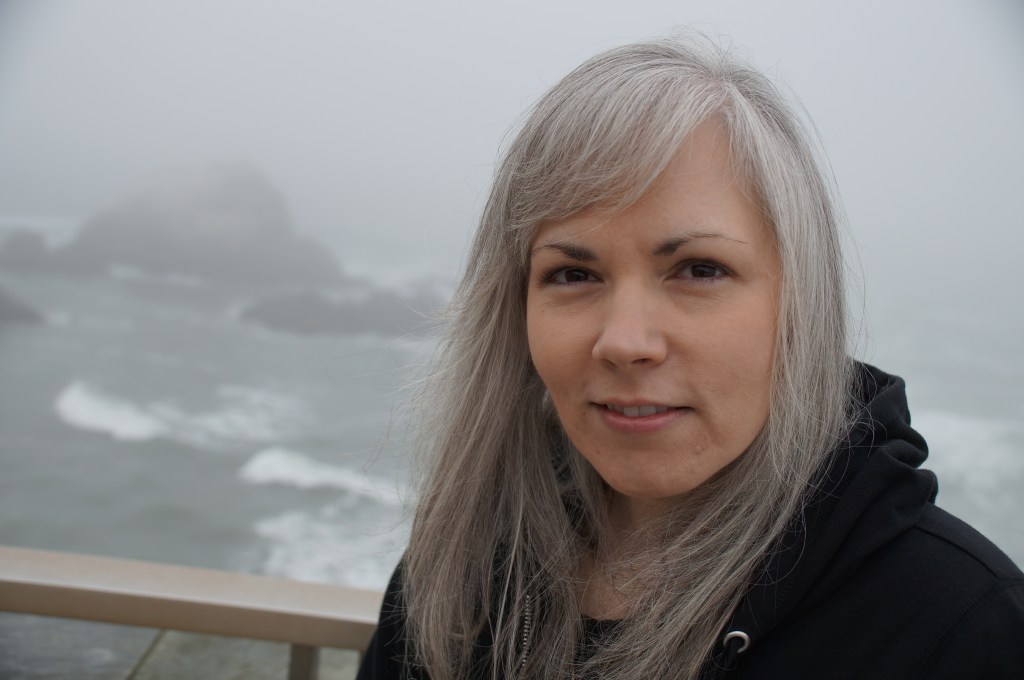
- Introduce yourself.
Hi, I’m Carisa H-K. I adopted that shorthand in business (Hodges-Kaplitz is a bit long), and it stuck as my pen name. I’m a tech sector lifer, and I’m embarrassed to say I’ve been at it long enough to have worked at web startups in apartments crawling with cockroaches and plagued by overflowing toilets, power outages, and crashing servers. From that tech trial by fire, I bring an insider’s interrogating, yet hopeful and humorous, perspective to the digital dilemmas shaping our world. Like Andy Weir and Daniel Suarez, I made the leap from technology to storytelling. My short stories are featured in anthologies by Dragon Soul Press and Kindred Writing Collective, and on DigitalDeliria.com. My debut speculative novel FIGMENTS (www.ReLifeStory.com) is forthcoming. My unique voice melds modern technology-touched concepts with gothic romanticism, unearthing the human stories hidden within our steely digital age. - What prompted you to begin writing?
Originally, my Chicagoland public school English teachers. They served as my first mentors, encouraging me to submit to essay contests. I was surprised to win a few, realizing the power of words early.
Many years passed and I gravitated toward visual arts and graphic design. I graduated from SMU Meadows School of the Arts and wholly invested myself in the creative act of building the web, including apps, educational online content, and software. After decades of that, I picked up the pen again to capture the human stories of growing up at the dawn of the internet, and how technology transformed us. This formed my online short story collection, TALES FROM DIGITAL DELIRIA (www.DigitalDeliria.com).
But the biggest moment came a couple months after my mom’s death in 2007. A vision for a series of books hit me like a lightning bolt. I called it THE RE-LIFE STORY series. I felt like the first to see it—an AI future that, now about 20 years later, is starting to happen. It took me just about as long to start writing the first book in the series (FIGMENTS), given my continuing, full focus on managing technology programs. But in recent years, I couldn’t hold it in anymore—it felt imperative to bring forth this human story of hope (and warning) about our technological AI future, informed by my decades in the tech industry. - Do you have a favorite story or poem you’ve written? What’s it about?
“CLERVAL, MY HEART”, which is a retelling of FRANKENSTEIN through the eyes of Henry Clerval. There’s a lot of talk now about AI as our modern-day Frankenstein, but I pursued a different direction with this one. When I recently revisited Shelley’s original, famous passages like “formed in the very poetry of nature” raised a big question: how can that NOT be an expression of absolute love for Clerval? Clearly to me, an uncommon love story was hidden in plain sight inside Mary Shelley’s FRANKENSTEIN, one that perhaps couldn’t have been written in her time. I subsequently became obsessed with bringing it forward, and I’m so proud that the story is now featured in the “Once Upon a Tale” anthology from Dragon Soul Press. I thoroughly enjoyed leaning into the “gothic romanticism” side of my writing style, and hope readers enjoy discovering a new and unexpected angle on a familiar story! - How many projects do you have planned over the next few years? Tell us about one.
I plan to continue writing THE RE-LIFE STORY series, and bringing FIGMENTS, the first book, to readers. It’s about Ellede, a STEMinist who hungers for a new opportunity to push her career into overdrive. She finds it at a company that enables the deceased to “live on” as interactive digital personas called “Figments”. She’s a believer: if not for the unwavering guidance from her Figment Mothers—3 generations of wise Matriarchs—she’d surely sink back into her wild, self-destructive depths. But when she discovers the company’s buried secrets, her illusions start to shatter. The deceptions peak when an equally feral hacker threatens her career, her family, and Jonathan, her love. Ellede must make a choice: to channel her wild or remain tamed, or said another way—to hack or be hacked. And when it comes to protecting those she loves the most, it’s a no-brainer: Ellede and Jonathan decide to double down and rally their team (both living… and dead) to help take the hacker down.
You’ll enjoy it if you’re into Speculative fiction, Fantasy, Sci Fi & Suspense/Thrillers, or if you like a touch of Dystopian, Romance & Horror. There’s a little something for everybody to enjoy in my genre blender.
Also on another level, I hope that through the book, people dealing with grief and loss feel seen.
After this series, I plan bring more Speculative/SFF stories to life, always with some grounded, emotional human element that becomes infused with tech in unexpected ways. Those things don’t often go together and that fascinates me. One of those projects might be novel or novella about caregiving. Those folks—the unseen caregivers—need to be seen too. - What is your writing process like?
I call my process “assemblage,” and it’s a bit of a contortion borne from the realities of life. I don’t want to instill bad habits in anybody, but for others like me—writers who are also caregivers, with full-time jobs, bobbing along in the sea of life’s demands—you might find this helpful to capture the words.
When I have a story concept, a scene, or an overall outline, I let my mind run in the background on it—all day, every day. I keep a very small notebook and a light-up pen by my bed at night. There, without disturbing my sleeping partner, I capture the whispering voices of my characters. The words come as small setting details, actions, thoughts & feelings, phrases. Sometimes I get full sentences, but generally, they’re short snippets. Often my brain goes over the same detail repeatedly, trying different phrasing, and then I must sort through and find the best one later. Dreams fuel different settings and plot points too, so I’m quick to jot all those fleeting things down. If not in my nighttime notepad, I use “Notes” in my phone to capture the stream.
As a side note, migraines often keep me up at night, and despite the pain, I find the words that I get then are copious. I think it’s something about the overactive electrical system in the brain. An entire outline for one of my books came between 2-4 A.M. during a migraine.
So what is “assemblage”?—it’s making sense of all those snippets, placing them in chronological story order, and fitting them like puzzle pieces into an organized, cohesive whole. Once assembled, I turn it into readable prose. That’s where I get the joy of seeing it come together—where others might make sense of it, and with any luck, enjoy it. - Where do you draw inspiration from?
Music. Many authors use visual mood boards as inspiration, but I tend to use playlists first, where different songs reflect specific characters, scenes, settings, vibes. (Here’s an example on Spotify for FIGMENTS: https://open.spotify.com/playlist/6a5USIjHwWAaPfXbc55uUD?si=fojcv5gwS6iWmUGwO3_Gyg&pi=7ByQkwPMQcKKg.) Now that I think of it, my “assemblage” writing process might well be “25 or 6 to 4” by Chicago.
Anyway, I also use music as a map of structure and cadence for my scenes, and I hope that musicality shows through to readers. In addition to music, I’m inspired by nature, dreams, human relationships, the work of other authors, researching emerging technologies and their impacts on humanity, and juxtapositions of science and the spirit. - Who is your favorite author / what is your favorite book?
This has changed over time. As a child, it was THE NEVERENDING STORY (Michael Ende). Do you remember the kid’s movie? That thing really pulled me in (Bastian, Atreyu, Falcor, and even sad, old Artax), but then I marveled at how much more fantastical and in-depth the book was in comparison to the film.
As a teen, it was SIDDHARTHA (Herman Hesse). I was swept up by the fascinating journey to enlightenment, reading it many times.
Currently, it’s KLARA AND THE SUN (Kazuo Ishiguro). Just a beautiful and heartbreaking human story, that felt to me like an affirmation of my story FIGMENTS—like a little encouraging nod from the ether. NEVER LET ME GO was also devastating and deeply meaningful. I love Speculative works that give insight into humanity and the evolving human/tech condition. Though it’s of another era, ENDER’S GAME might also fall in this category—a book that was recently recommended to me by several Sci Fi enthusiasts. A mightily devastating read there, as well! - What is one goal you have for your writing future?
Keep writing. And with bulldog tenacity, find good homes for my work so I may reach others who might take meaning, emotional insights, and enjoyment from it. - What do you hope readers enjoy most from your work?
Engaging characters on unforgettable journeys that blend visceral human emotion and technology twists. That’s what makes my work unique—mashing things together that usually don’t go together to make something interesting! And doing it with humor, humanity and heart, kind of like if KLARA and the MURDERBOT blended in a BLACK MIRROR episode.
Hopefully readers will enjoy a wild, amusing ride with FIGMENTS, and leave with some piece of them feeling more fulfilled, too. I often think, if I don’t hit something deep, something meaningful—somehow touching the origin within every human’s heart—then why bother? - Where can readers learn more about you?
www.ReLifeStory.com (Check it out for a free sample of FIGMENTS)
www.CarisaHK.com
www.DigitalDeliria.com
Instagram: @DigitalDeliria, @CarisaHodgesKaplitz
Facebook: @DigitalDeliria
YouTube: @DigitalDeliria
X: @CarisaHK
Amazon Author Profile: https://www.amazon.com/author/carisah-k

